
 By Alice Rose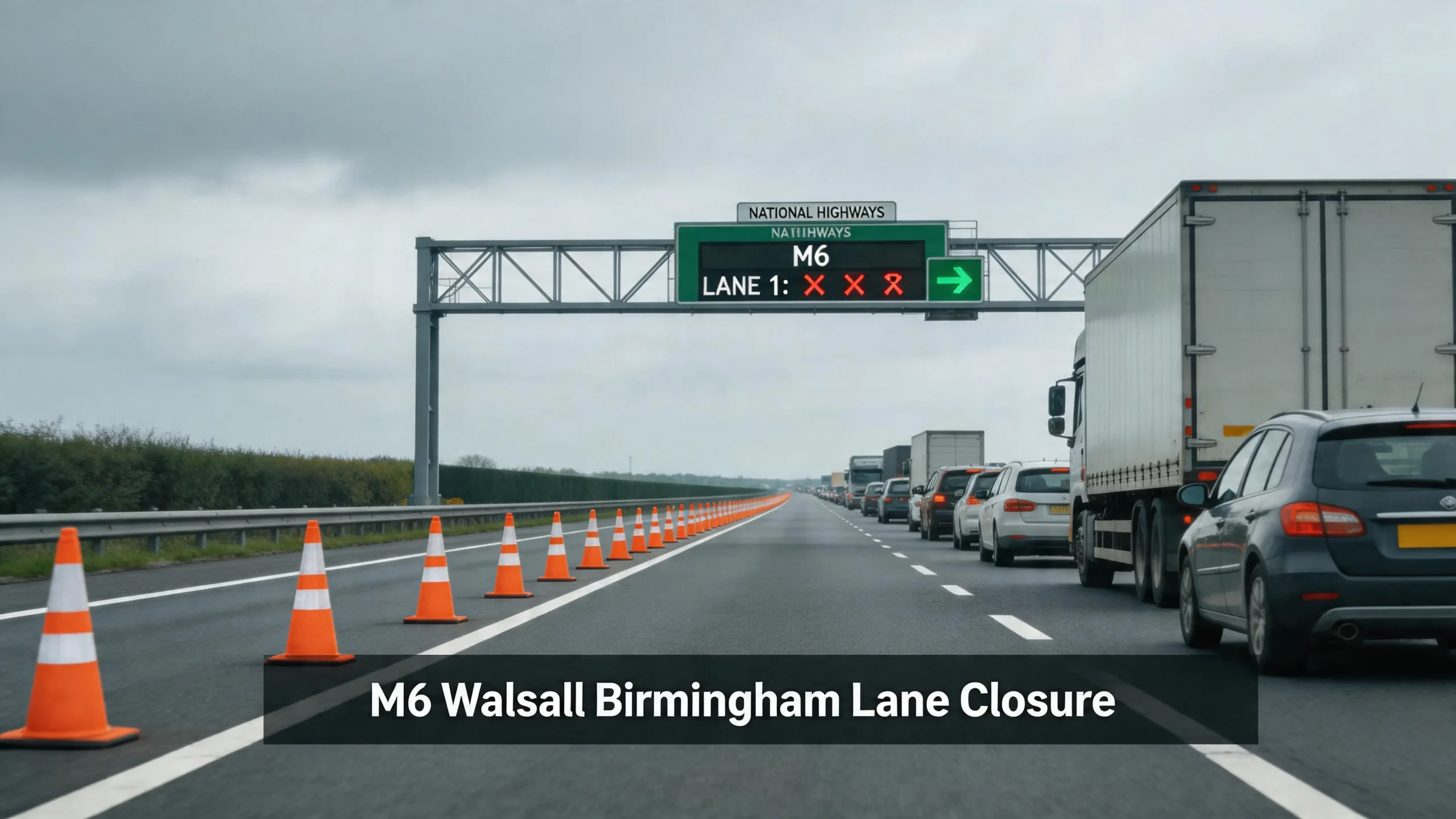
You set your alarm, grab a coffee, and head out thinking you have plenty of time. Then you join the M6 somewhere near Walsall, and everything grinds to a halt. The lanes are down, cones stretch as far as you can see, and the sat-nav is already rerouting. Sound familiar? If you use this stretch of motorway regularly, this has probably happened to you more than once in 2026, because the M6 Walsall Birmingham lanes closure situation is more complex and longer-lasting than most drivers realise.
This is not just one repair job finishing and going away. It is an extended period of works, barrier repairs, resurfacing, and infrastructure upgrades across several junctions between Walsall and Birmingham. Understanding exactly what is happening, where it is happening, and when it is most likely to affect your journey will genuinely save you time, fuel, and frustration.
What Is Actually Happening on the M6 Between Walsall and Birmingham
The M6 Walsall Birmingham lanes closure covers a corridor that runs through some of the busiest junctions in the entire West Midlands motorway network. The stretch most commonly affected sits between Junction 10 near Walsall and Junction 6 approaching Birmingham, with particularly intense activity between Junction 7 at Great Barr and Junction 6 near Spaghetti Junction.
The current round of works includes bridge joint replacement, barrier repairs, resurfacing, and what National Highways describes as phased overnight full carriageway closures on both northbound and southbound sections. Based on the latest confirmed schedule, major northbound closures between Junction 6 and Junction 7 were active from 7 April and are planned to run through to mid-June 2026, with separate southbound works beginning at the end of April. That is an unusually long window, and it means drivers cannot expect conditions to return to normal any time soon.
What makes this harder to manage is that different sections carry different closure timings. One stretch might be shut for a full carriageway overnight closure while a neighbouring section is running on lane restrictions only. A driver checking one update may miss that an adjacent junction is also reduced, which means the total effect on journey time is often worse than any single notice suggests.
Why the Walsall to Birmingham M6 Section Is So Sensitive to Disruption
Not every motorway reacts the same way to lane closures. Some stretches can absorb a lost lane without too much trouble because traffic volumes are moderate. The M6 between Walsall and Birmingham is not one of those stretches. This corridor carries an enormous daily load of commuter vehicles, heavy goods lorries, delivery vans, airport traffic heading toward the M42 and Birmingham Airport, and long-distance drivers using this as a key north-south link.
Junction 10 alone is one of the most heavily used motorway junctions in England, with traffic feeding in and out from Walsall town and surrounding areas. Junction 7 serves Great Barr and acts as a relief point for drivers trying to bypass the worst of central Birmingham. Junction 6 is where the motorway meets Spaghetti Junction, one of the most complex road interchanges in the country. When you put lane restrictions across any part of this chain, the result is not just a localised slowdown. It creates a compression effect where merging becomes harder, braking distances close up, and queues form and then spread backward along the route at speed.
Emergency barrier repairs in late March 2026 showed just how quickly this can escalate. Two lanes were closed in both directions simultaneously between Junction 7 and Junction 6, and the official delay estimate was around 30 minutes on approach. That was during off-peak conditions. During a morning or evening rush, the same closure on the same stretch would produce significantly longer delays.
The Closure Schedule and What It Means in Practice
National Highways has confirmed a structured programme of works for this section of the M6, with the following broad phases relevant to drivers using the Walsall to Birmingham corridor. Most overnight works operate between 9pm and 6am on weeknights, with full carriageway closures used when the nature of the work makes it impossible to keep any lanes running.
Northbound closures between Junction 5 and Junction 7 are confirmed as ongoing from 23 April 2026 through to early June, with nightly disruption windows and periodic full closure nights mixed in. Southbound lane closures between Junction 5 and Junction 6 are also scheduled across multiple date windows in late April and throughout May. Separately, the section between Junction 10 and Junction 10A northbound has confirmed barrier repair closures scheduled from 29 April into early May with two of three lanes shut during overnight hours.
What this means for a driver using this route is that you should not assume any night-time journey from mid-April through to at least mid-June will be straightforward. Even if the specific section you use has no closure tonight, a nearby section in an earlier or later phase may have finished earlier than planned, or emergency works could have added a new restriction that was not in the original schedule. National Highways themselves note clearly that closures can change at short notice.
How These Closures Affect Commuters, Freight, and Regional Travel
For daily commuters, the most frustrating part of the M6 Walsall Birmingham lanes closure is the unpredictability. A driver who left at the same time on Tuesday with no problems can find themselves sitting in serious congestion on Wednesday because the overnight crews ran over time, or because a separate incident happened near Junction 9 on the Wednesbury approach. This route does not forgive a lack of planning the way quieter roads might.
For freight and logistics traffic, the stakes are higher still. Heavy goods vehicles make up a significant proportion of M6 traffic through this section, and they take longer to slow, stop, and accelerate than passenger cars. When lanes are reduced, lorries need more time to merge safely, which adds to the overall slowdown. Delivery windows, shift start times, and cross-regional distribution chains all absorb the cost of delays on this corridor, and those effects ripple outward into the businesses and services that depend on punctual deliveries.
The wider regional picture matters too. A driver traveling from the north toward the M5 or M40, or coming up from the south toward Staffordshire or Cheshire, will pass through this section whether they want to or not. The M6 Walsall Birmingham corridor is not easy to avoid on a long-distance trip unless you make a deliberate and significant detour using the M6 Toll, which adds its own cost.
Alternative Routes and When They Actually Help
When the M6 is restricted between Walsall and Birmingham, many drivers immediately look at diverting. The most common options are the A34 Birmingham Road, the A454, or using the M6 Toll as a paid alternative around the busiest section. Each has its place, but none of them is a perfect solution in every situation.
The A34 can carry a reasonable amount of diverted traffic, but when sat-nav systems send thousands of vehicles down the same road at the same time, it fills up fast. Local roads around Walsall town centre, Great Barr, and the northern outskirts of Birmingham were not designed to absorb motorway-level diversions, so the congestion simply relocates rather than disappears. If you use the A34 as a diversion, leaving earlier than the main wave of diverted traffic can make a real difference.
The M6 Toll is genuinely useful if you are doing a longer journey and the toll cost is acceptable to you. It bypasses the most congested section between Junction 4 and Junction 11A, and because it carries far lower daily volumes than the main M6, it tends to stay free-moving even when the free route is heavily restricted. For a one-off delayed journey, the toll cost is usually worth it. For daily commuters, that adds up over weeks of closure windows.
The real lesson here is that there is no single alternative that works for every driver in every situation. Your best diversion depends on your destination, the time of day, whether the closure is a planned overnight restriction or a live incident, and how much delay you can actually absorb.
What You Should Do Before Every Journey on This Route
The most effective thing any driver can do during this extended period is to treat a quick traffic check as a non-negotiable step before leaving. Spending two minutes on the National Highways Traffic England website or checking a reliable traffic app before you set off can completely change the quality of your journey. It tells you whether tonight’s planned closure is active, whether an incident has added extra delay on top of the planned works, and whether the direction you are traveling is worse or better than the opposite one.
Checking direction matters more than people often think. Northbound and southbound conditions on this stretch are genuinely different during many closure windows, because the works are being done in phases on each side. A driver heading toward Birmingham might find the southbound carriageway running freely while the northbound route out of the city is completely shut with a diversion in place. Getting that detail right before you leave gives you real choices.
Allowing extra time is the other obvious but often ignored piece of advice. If your normal journey takes 25 minutes on this route, adding 20 to 30 minutes of buffer during the current closure period is a reasonable precaution. That way, a delay does not become a crisis.
Staying Safe Through the Works
Driver behaviour inside and around motorway work zones has a direct effect on how well traffic flows and how safe the work crews are. On a route as busy as this one, the temptation to change lanes late, push into gaps, or accelerate past the reduced speed limit is understandable but genuinely counterproductive. Lane changes at the last moment cause the driver behind to brake hard, which triggers a chain of braking backward through the queue. That is one of the main reasons delays stretch so far behind a closure.
Following posted speed limits through work zones is also a legal requirement, not just a suggestion. Speed cameras are active in many motorway work zones, and the fines are significant. More importantly, work crews are operating in live lanes or just off the edge of them. The reduced speed limit exists to give those workers a margin of safety and to give drivers time to react if something unexpected happens.
Keeping a steady gap from the vehicle in front, moving into the correct lane before you reach the closure point, and staying patient through the slowdown all genuinely reduce how bad the congestion gets. It sounds simple because it is, but it makes a measurable difference.
Frequently Asked Questions
What is the M6 Walsall Birmingham lanes closure and why is it happening?
The M6 Walsall Birmingham lanes closure refers to a series of planned roadworks, barrier repairs, and resurfacing projects affecting the motorway between Junction 10 near Walsall and Junction 6 near Birmingham. Works are being carried out by National Highways to maintain and improve one of England’s busiest motorway corridors.
Which junctions are most affected by the closures?
The most disrupted areas are Junction 10 near Walsall, Junction 7 at Great Barr, and Junction 6 approaching Birmingham’s Spaghetti Junction. Junction 9 near Wednesbury has also seen related congestion, and Junction 10A to J11 northbound has confirmed barrier repair closures from late April 2026.
When do the closures usually operate?
Most planned works take place overnight between 9pm and 6am on weeknights. However, during phases requiring full carriageway closures, the road may be completely shut in one direction with signed diversions to the next junction and back. Drivers should always check the latest update as timings can change at short notice.
How long are delays likely to be?
During peak commuter hours with lane restrictions active, delays of 30 to 60 minutes have been recorded on approach. Emergency closures such as the March 2026 barrier repairs created around a 30-minute delay even outside rush hours. During morning and evening peaks, actual delays can be longer.
Will these closures continue for a long time?
Yes. The current programme of works runs through to at least mid-June 2026 for northbound sections between Junction 6 and Junction 7, with southbound closures and separate section works also confirmed into May. Drivers using this route regularly should expect changing conditions throughout this period.
Conclusion
The M6 Walsall Birmingham lanes closure is not a short-term inconvenience that is about to wrap up. It is an extended, multi-phase programme of essential maintenance and infrastructure improvement across one of the most important stretches of motorway in the West Midlands.
With confirmed works running through junctions 6, 7, 9, 10, and 10A from April well into June 2026, drivers need to treat this as an ongoing reality rather than a one-off delay. The road needs this work to remain safe and functional, and the planned overnight approach is the most manageable way to get it done.
But for anyone using this route for commuting, freight, or regional travel, the message is clear. Check before you travel, allow extra time, know your alternative options, and stay patient when traffic slows. A little preparation on this corridor goes a long way, and drivers who plan ahead consistently have a much smoother experience than those who arrive at the junction hoping for the best.
Category: Travel