
 By Alice Rose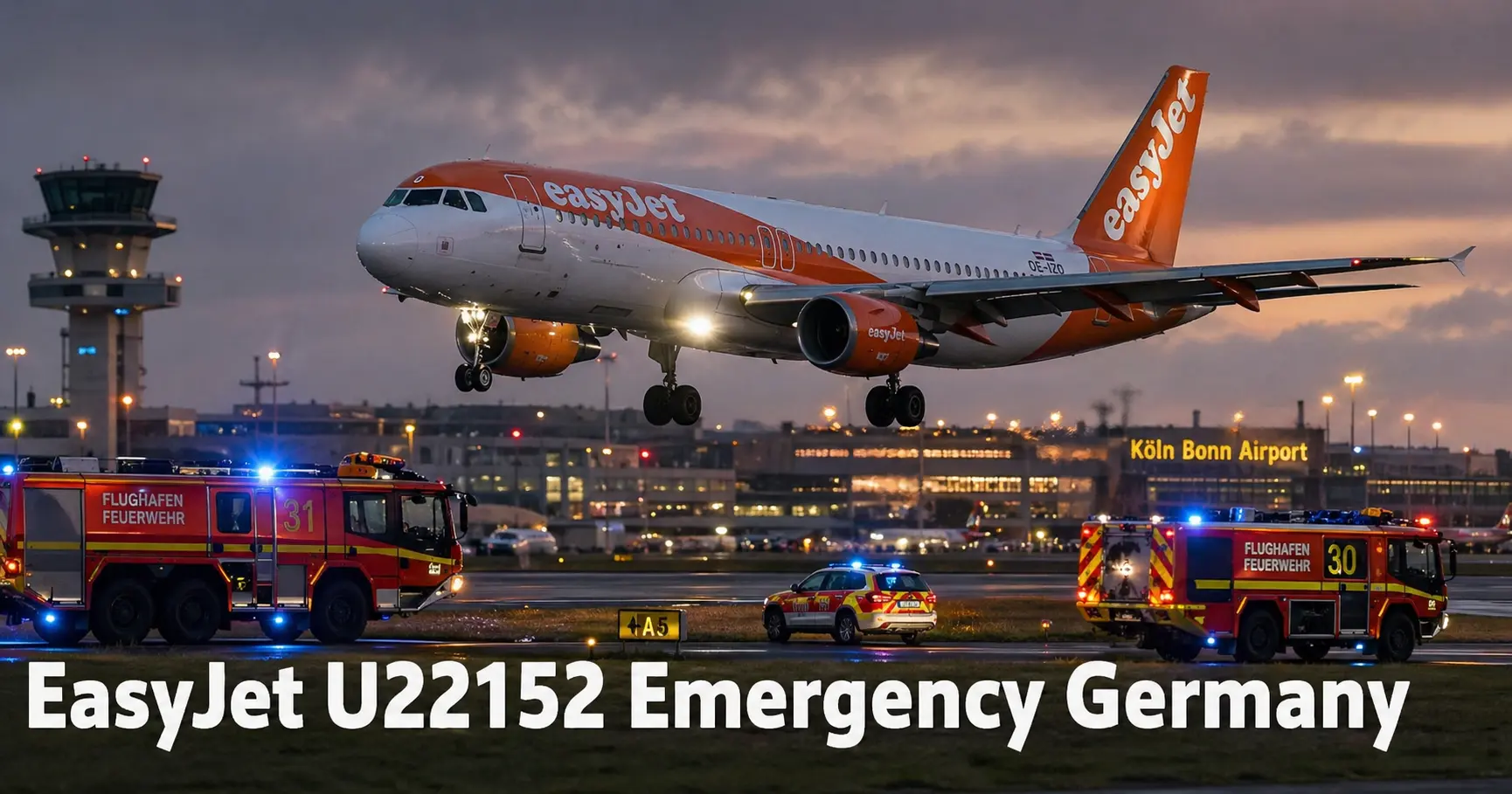
Picture this. You’re sitting on a routine flight from Istanbul to Manchester, seat belt sign switched off, a drink in your hand, everything perfectly normal. Then without any warning, the seat belt signs flash back on. The cabin crew quietly stop their service. The plane begins to turn. Something has clearly changed — but nobody around you is panicking.
That’s exactly the moment 185 passengers experienced on the EasyJet U22152 emergency Germany flight, a real aviation incident that unfolded on 15 August 2025 and quickly became one of the most talked-about flight diversions across the UK and Europe.
This article covers everything — the verified cause, the full timeline, how the crew responded, what passengers actually went through, and what the whole incident tells us about the true safety of modern commercial flying.
What Was Flight U22152 and Where Was It Going?
Flight U22152 is a regularly scheduled easyJet service operating between Istanbul Airport in Turkey and Manchester Airport in the United Kingdom. The route covers roughly 1,650 miles and typically takes around four to four and a half hours to complete. The aircraft used on this route is from the Airbus A320 family — one of the most commonly flown short-to-medium-haul jets in the world.
On 15 August 2025, the specific aircraft operating the service was an Airbus A320-214 registered as G-EZWT. It departed Istanbul on time, lifting off from runway 35L without any reported technical issues. The flight carried 185 people on board that day, including both passengers and crew.
For the first two hours, everything was completely routine. The seat belt sign had been switched off after reaching cruising altitude at 36,000 feet. Passengers were relaxed, cabin crew were moving through the aisles, and there was absolutely no indication that anything unusual was about to happen. That changed fast.
The Moment Everything Changed Mid-Air
Roughly two hours into the cruise, while the aircraft was passing over central Europe at flight level 360, something happened inside the cockpit that triggered an immediate response. The seat belt signs came back on without the usual announcement. Passengers noticed the change but didn’t immediately understand why.
The reason was serious. The first officer became suddenly and severely unwell during the flight. Symptoms consistent with acute food poisoning developed rapidly, leaving him incapacitated and unable to continue performing his duties. With only one pilot now available to fly the aircraft and 185 people depending on him, the captain made the only correct decision — he declared an emergency.
At 15:41 UTC, the aircraft began broadcasting squawk 7700, which is the internationally recognised emergency transponder code used by pilots worldwide. The moment those four digits appear on a radar screen, every air traffic control facility in the surrounding airspace is alerted simultaneously. German ATC responded immediately, clearing a priority path straight to Cologne Bonn Airport. According to verified aviation tracking records, the aircraft touched down on Cologne’s runway 32R approximately 27 minutes after the diversion decision was made. That is an incredibly fast and controlled response under genuine pressure.
Why the First Officer Collapsed — The Verified Cause
There has been a lot of speculation online about what caused the EasyJet U22152 emergency Germany incident. Some reports mentioned pressurisation issues, others suggested technical faults or bird strikes. All of those claims are inaccurate for this specific flight.
Verified aviation records confirm that the cause was entirely medical. The first officer experienced sudden severe abdominal pain consistent with food poisoning. No hospital confirmation of the exact cause was ever made public, and easyJet’s own official statement did not name a specific diagnosis. However, the symptoms and timeline are consistent with acute gastric illness.
This kind of incident is more common in aviation than most people realise. According to data compiled by aviation safety researchers, stomach illness and gastric trouble account for a significant proportion of all pilot incapacitation cases recorded globally. Airlines are aware of this risk, which is why strict crew meal separation rules exist — pilots on the same flight are required to eat different meals to reduce the chance of both being affected simultaneously. On flight U22152, only the first officer was taken ill. The captain remained completely unaffected and flew the diversion safely and without incident.
Why Cologne and Not Another German City?
A question many people ask is why the flight didn’t continue to Manchester or divert somewhere else. The answer comes down to speed, geography, and medical access.
Germany sits at the heart of European airspace, making it a natural diversion point for flights crossing central Europe. Cologne Bonn Airport was the closest suitable airport at the moment the captain made his decision. It has long runways capable of handling an Airbus A320, a fully equipped medical response team on standby, and advanced hospital facilities within a short distance of the airport.
For a captain with an incapacitated co-pilot, the goal is always the same — get on the ground as fast as possible at the most suitable airport available. Cologne was exactly that. The decision wasn’t about choosing the biggest or most prestigious airport. It was about getting the first officer to proper medical care as quickly as possible while ensuring the safety of everyone on board.
How the Passengers Experienced the Diversion
From a passenger’s perspective, the EasyJet U22152 emergency Germany diversion would have felt sudden but surprisingly controlled. Multiple passengers who posted real-time updates described the atmosphere as tense but calm. The cabin crew paused normal service, secured the cabin, and prepared everyone for an unscheduled landing without causing unnecessary alarm.
The captain made several announcements explaining that a crew member required urgent medical attention and that the flight needed to land in Germany. Passengers reported hearing a noticeable change in engine noise as the aircraft descended and banked away from its original route. When the aircraft landed at Cologne, emergency vehicles were visible on the runway — a standard precaution for any declared emergency landing, not a sign that something had gone catastrophically wrong.
easyJet released an official statement approximately 90 minutes after landing confirming the diversion. The airline described it as a precautionary landing due to a crew member requiring urgent medical assistance, and confirmed the aircraft had landed normally with all passengers and crew safe.
By 18 August 2025 — just three days after the incident — easyJet confirmed that the affected first officer had been discharged from hospital and was recovering well at home.
What Happened After Landing in Cologne
Once the aircraft was safely on the ground and the first officer had been handed over to medical teams, easyJet arranged for a replacement pilot to fly the aircraft onward to Manchester. The passengers remained informed throughout the delay period, and the aircraft eventually completed its journey to Manchester the same day.
The aircraft itself was inspected by engineers during the Cologne stop. Because this was a purely medical diversion with no mechanical fault involved, the inspection confirmed the aircraft was in full working order and it was cleared to return to service immediately. German aviation authorities classified the event as an incident rather than an accident, which is the standard classification for medical diversions where the aircraft sustains no damage.
As of early 2026, no formal investigation report had been published by either the UK Air Accidents Investigation Branch or Germany’s Federal Bureau of Aircraft Accident Investigation. For a crew incapacitation event that did not result in an accident, that is entirely normal procedure.
What This Incident Reveals About Aviation Safety
The EasyJet U22152 emergency Germany event is genuinely reassuring when you understand what it shows. Not because nothing went wrong — something clearly did. But because every single layer of aviation safety worked exactly as it was designed to work.
The first officer became ill. The captain declared an emergency without delay. Air traffic control cleared an immediate path. Ground teams were ready on arrival. The aircraft landed safely. The passenger was taken to hospital. A replacement pilot was arranged. The flight continued. And three days later, the first officer was home recovering.
easyJet holds a strong safety rating and was ranked among the safest low-cost airlines in the world in 2024. The U22152 incident didn’t damage that reputation — it actually reinforced it. Not one of the several medical emergency diversions easyJet dealt with in 2024 and 2025 resulted in passenger injuries.
Modern commercial aviation has built so many layers of redundancy and protocol into every flight that even a genuine emergency at 36,000 feet, with one pilot down and 185 people on board, ends with everyone walking away safely. That’s not luck. That’s years of training, strict procedures, and systems designed specifically for moments like this one.
Frequently Asked Questions
Was the EasyJet U22152 emergency Germany a crash?
No. The aircraft landed safely at Cologne Bonn Airport without any damage, injuries to passengers, or structural issues. It was a medical diversion, not an accident.
What caused the EasyJet U22152 emergency Germany incident?
The first officer became incapacitated mid-flight due to symptoms consistent with food poisoning. The captain declared an emergency and diverted the aircraft to the nearest suitable airport.
Were passengers on EasyJet U22152 in any danger?
No passengers were in danger at any point. The captain remained fully fit and in control throughout. Emergency procedures were followed correctly and the landing was completely safe.
Are passengers entitled to compensation for the EasyJet U22152 delay?
This is a debated point. Some sources suggest passengers may have been entitled to compensation under UK and EU flight delay regulations given the length of the delay. However, airlines can argue medical emergencies constitute extraordinary circumstances. Anyone affected should check directly with easyJet.
How common are pilot incapacitation incidents in aviation?
They are rare but not unheard of. Gastric illness is actually the most common single category of pilot incapacitation recorded in aviation safety data. This is why strict crew meal rules exist — to prevent both pilots being affected by the same food source simultaneously.
Conclusion
The EasyJet U22152 emergency Germany incident on 15 August 2025 was a genuine in-flight emergency that could have been frightening for everyone involved. A first officer collapsed at 36,000 feet with 185 people on board, and the flight had to be diverted urgently to Cologne, Germany. Yet the outcome was safe, controlled, and efficient from start to finish.
What this incident really demonstrates is how seriously modern aviation takes every possible scenario. Pilots train for exactly these situations. Procedures are built around the possibility that something unexpected will happen. Air traffic control systems are designed to respond within seconds. And airlines like easyJet have protocols covering everything from the emergency declaration to the replacement crew and the passenger communication that follows.
If anything, the EasyJet U22152 emergency Germany story should make you feel more confident about flying — not less. When something goes wrong in the sky, there’s an entire network of trained professionals and tested systems ready to bring you home safely. And in this case, that’s exactly what happened.
Category: News