
 By Alice Rose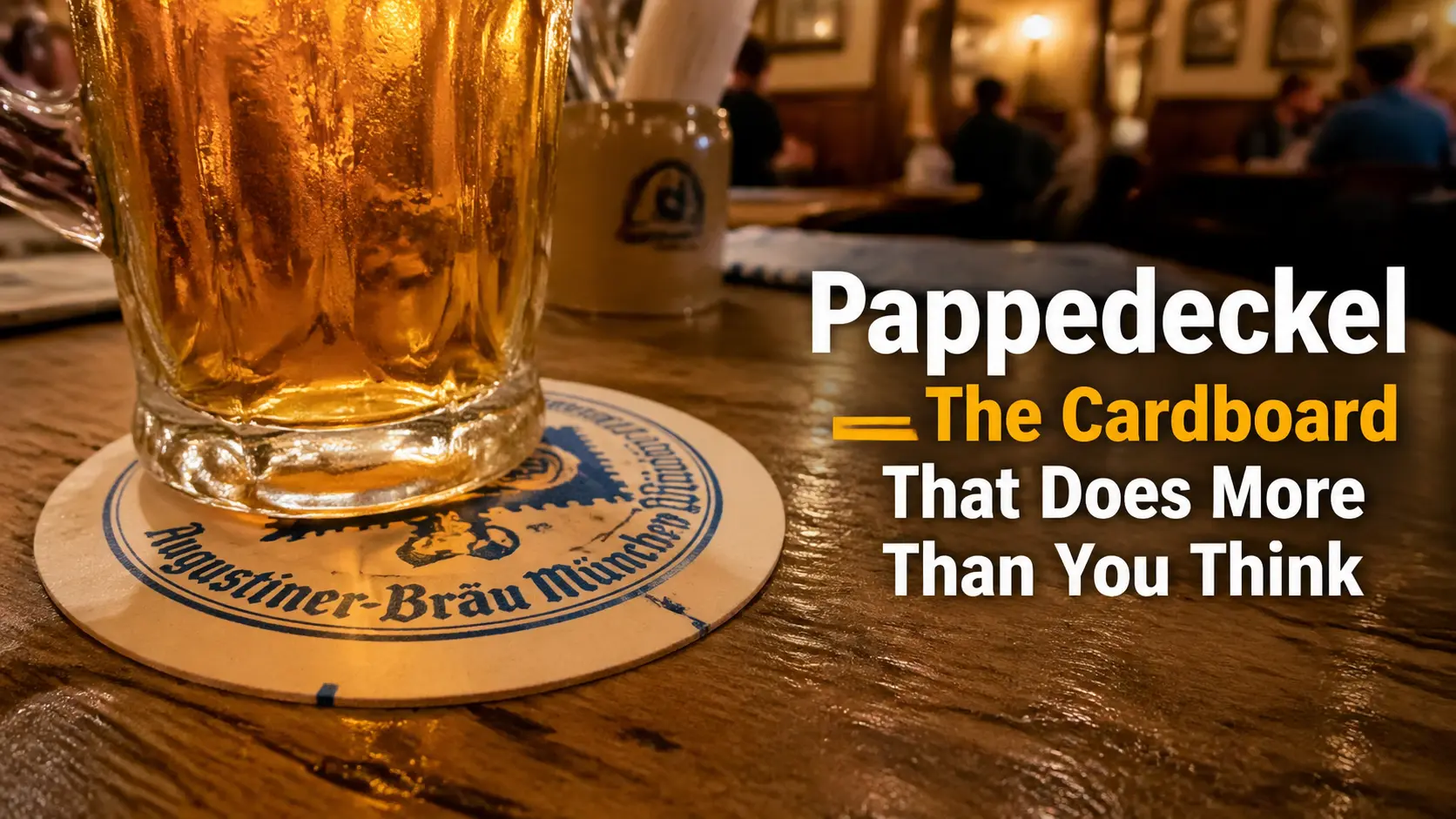
You walk into a traditional German pub. The bartender slides a cold glass of beer toward you without saying a word. But right under that glass, there’s a small round piece of cardboard. It absorbs the condensation, protects the table, and somewhere on its surface, a tiny pen mark appears — one mark for one drink. No app, no receipt, no digital display. Just a pappedeckel and a little bit of trust.
That’s the thing about pappedeckel. It doesn’t announce itself. It doesn’t try to impress you. It just sits there, doing what it was made to do, while you go on with your evening. And yet, if you removed it from the picture, something would feel off. Something would feel missing. That quiet kind of usefulness is rare — and honestly, it’s worth talking about.
What Pappedeckel Actually Means and Where It Comes From
The word pappedeckel comes from the German language. Papp means cardboard or thick paper, and deckel means lid or cover. So at its most literal, it’s a cardboard cover. But in everyday German life, the word carries a very specific meaning — it refers to those round, slightly thick cardboard coasters you find in almost every traditional pub or Gasthaus across Germany, Austria, and Switzerland.
The history of pappedeckel as a coaster dates back well over a century. German beer culture has always valued ritual and order, and the coaster became a natural part of that ritual. Breweries started printing their logos on pappedeckels as far back as the late 1800s. By the early 1900s, they were standard in nearly every establishment that served beer. The idea spread across Europe, and while different countries adopted similar objects, the German pappedeckel developed its own cultural identity — especially because of how it was used for tracking tabs.
In many traditional pubs, digital billing systems simply don’t exist. The bartender keeps your running tab by making small marks on the coaster sitting under your glass. One mark, one drink. When the evening ends, you count the marks, you pay, and that’s it. The whole system works because both sides — the customer and the bartender — trust the process. There’s something genuinely human about that.
Why the Pappedeckel Is More Than Just a Coaster
A lot of people outside of Germany hear the word pappedeckel and immediately picture a simple drink coaster. And yes, that’s part of what it is. But reducing it to just a coaster misses most of the story.
The pappedeckel is, at its core, a multitasking object that somehow never feels like it’s trying too hard. The physical function is obvious — it sits beneath a cold glass and prevents condensation from pooling on the table surface. That alone protects wooden bar tops from moisture damage that adds up over years of service. A good pappedeckel absorbs a surprising amount of liquid before it starts to break down, which means it often lasts through an entire evening without needing to be replaced.
But the billing function is what really makes it stand out. Bars and pubs in Germany have been using pappedeckels as informal ledgers for generations. The bartender draws a short line for every drink ordered. Sometimes the marks go along the edge of the coaster. Sometimes they go across the printed brewery logo. There’s no universal system — every bartender develops their own shorthand. But it works, almost everywhere, almost every time.
Beyond the functional side, the pappedeckel has become a kind of cultural artifact. Breweries have long understood that a coaster sitting on a table in front of a customer is essentially a small billboard. Hundreds of breweries — Paulaner, Weihenstephan, Erdinger, Bitburger — have designed branded pappedeckels that have been collected by enthusiasts for decades. Coaster collecting, known as tegestology, is an actual hobby with an actual community. Some vintage pappedeckels from the early 20th century sell for real money among collectors.
Then there are the things people do with pappedeckels that nobody officially planned. Pub conversations get long. Pens appear from somewhere. Suddenly a coaster becomes a napkin sketch for a business idea, a place to write down a phone number, a mini canvas for someone who’s had two drinks and thinks they’re an artist. These unplanned uses are part of what makes the pappedeckel endearing. It absorbs not just moisture, but moments.
The Design Behind Something That Looks Simple
At first glance, a pappedeckel looks like a circle of cardboard. But manufacturers actually put a fair amount of thought into the design, and the differences between a good pappedeckel and a cheap one are noticeable when you use them regularly.
The standard pappedeckel is made from compressed pulp board. This gives it the right balance of stiffness and absorbency. Too stiff, and it doesn’t absorb well. Too soft, and it disintegrates after a single drink. The diameter is typically around 107 millimeters, which is the European standard for coasters and fits most beer glasses without leaving too much exposed table surface. Thickness matters too — a standard pappedeckel sits somewhere between 3 and 4 millimeters, giving it enough body to hold up through a long evening.
The surface is usually printed on both sides. One side carries the brewery branding, the other sometimes has a plain finish to allow for writing. The edges are often slightly beveled or smooth-cut to prevent fraying. It sounds like a minor detail, but a rough edge on a coaster means small bits of cardboard end up floating in someone’s beer, which nobody wants.
Premium pappedeckels are made with food-safe inks and coatings, which matters because these objects spend their whole lives in contact with drinks and table surfaces. Some modern versions include a slight wax or polymer coating on the underside to reduce how much the coaster sticks to the table when wet — a small innovation that makes picking up a glass much less awkward.
How Pappedeckel Fits Into Sustainable Culture Today
Something interesting has happened over the last decade or so. The pappedeckel, which many assumed would become obsolete in the age of digital payment systems and contactless tabs, has actually gained a kind of renewed appreciation. Not everywhere, and not dramatically, but noticeably.
Part of this comes from a broader cultural shift toward sustainability. Pappedeckels are made from recycled or recyclable materials. They biodegrade. They don’t require plastic, electricity, or rare materials to produce. In a bar or restaurant that’s trying to reduce its environmental footprint, a paper coaster beats a plastic or silicone one in almost every category.
There’s also the question of digital fatigue. Plenty of bar owners — especially in smaller, community-oriented establishments — have found that customers respond positively to analog systems. A pappedeckel tab system feels personal. It creates a moment of actual interaction between the person behind the bar and the person in front of it. That’s harder to replicate with a tablet or QR code.
Craft breweries in North America, the UK, and Australia have also picked up on the pappedeckel as a branding tool. Custom-printed coasters have become a standard part of taproom culture. A well-designed coaster gives customers something tangible to take home, something that carries the brewery’s identity without being a sticker or a keychain. Several craft beer brands have reported that coasters left on tables drive measurable social media engagement when customers photograph their drinks — the coaster becomes part of the image, part of the brand story.
Common Mistakes People Make with Pappedeckels
If you’re running a bar or even just using pappedeckels at home, a few habits make the experience noticeably worse. The most common mistake is using coasters that are too thin. Thin cardboard soaks through quickly and leaves a wet ring on the table anyway, which defeats the entire purpose. A quality pappedeckel should absorb condensation from at least two or three drinks before showing signs of saturation.
Another mistake is replacing coasters too soon if you’re using them for tab tracking. Bartenders sometimes switch out a coaster mid-evening, which creates confusion about the running count. The system works best when one coaster tracks one customer through one visit.
On the branding side, bars sometimes order pappedeckels with printing so dark or complex that there’s no usable space left for writing. A good branded coaster leaves at least one relatively clear area where marks can be made legibly. It sounds obvious, but it’s a genuinely common oversight.
Finally, storing pappedeckels in damp conditions before use is a mistake that shortens their lifespan dramatically. Cardboard stored in a humid environment arrives at the table already partially degraded. A dry storage space makes a significant difference in how long each coaster holds up during service.
Pappedeckel Around the World — The Same Idea, Different Names
The concept behind the pappedeckel isn’t unique to Germany. Almost every culture that developed a pub or tavern tradition ended up inventing something similar. In the UK, drink mats have been standard since the Victorian era, and British breweries have been printing branded mats since at least the 1920s. In Belgium, coasters are equally embedded in café culture, particularly in Flemish beer establishments.
In the United States, coasters exist but haven’t historically carried the same cultural weight as in Europe. American bar culture tended toward faster service and digital payment systems, which reduced the need for pappedeckel-style tab tracking. But as the craft beer movement grew and taprooms became community gathering spaces, the humble coaster started making a stronger appearance — often as a deliberate nod to European traditions that American craft brewers admired.
Japan has its own version, typically made with higher-quality materials and often featuring intricate printed designs. Japanese bar culture takes presentation seriously, and the coaster is no exception. In some Tokyo bars, coasters are changed every time a new drink arrives, turning what’s elsewhere a practical object into something closer to a small gift.
What’s interesting across all these variations is that the core function never changes. It protects the surface. It marks the moment. It carries identity. Those three things are what make the pappedeckel — by whatever name it travels under — a genuinely durable idea.
Pro Tips for Getting the Most Out of Your Pappedeckel
If you’re a bar owner thinking about how to use pappedeckels well, the most practical thing you can do is invest in quality and design them with actual use in mind. A pappedeckel that’s interesting to look at gets photographed. A pappedeckel that holds up through an evening earns customer trust. A pappedeckel with enough blank space for a few marks works as a tab. Those three qualities together make it an asset, not just a throwaway item.
If you’re collecting pappedeckels as a hobby, focus on condition and brewery history. Coasters from smaller regional breweries that have since closed are often harder to find and more valuable than coasters from major brands. Dating a pappedeckel can sometimes be done through the printing style and the brewery logo design, since many breweries updated their visual identity in recognizable ways across different decades.
If you’re just someone who wants their table to not get wet, the practical advice is simple: use thicker coasters, replace them before they fully saturate, and keep them dry in storage. That’s really all there is to it.
Frequently Asked Questions
What does pappedeckel mean in English?
Pappedeckel translates from German as “cardboard lid” or “cardboard cover.” In common usage, it refers specifically to the thick cardboard coasters used in German pubs and bars, often also used by bartenders to track drink tabs.
Is a pappedeckel the same as a regular coaster?
Not exactly. While a pappedeckel functions as a coaster, it has a stronger cultural role in German-speaking countries — particularly as a manual billing system where bartenders mark drinks directly on the cardboard.
Can pappedeckels be collected?
Yes. Coaster collecting is called tegestology and has a dedicated international community. Vintage or rare brewery pappedeckels, especially from closed regional breweries, can carry real value among collectors.
Are pappedeckels eco-friendly?
Generally, yes. Most pappedeckels are made from recycled pulp board and are biodegradable, making them a more sustainable choice compared to plastic or silicone coasters.
Why do some bars still use pappedeckels for billing instead of digital systems?
Many traditional bars prefer the pappedeckel system because it’s personal, requires no technology, and creates a natural interaction between bartender and customer. It also works reliably without power outages, app glitches, or system crashes.
Conclusion
The pappedeckel is one of those ideas that never had to fight for its place. It earned it, quietly, over more than a hundred years of actually being useful. It protects surfaces, tracks tabs, carries brand identity, sparks conversations, and occasionally becomes the canvas for someone’s best idea of the night. It does all of that without needing an update, a plug, or a tutorial.
What makes pappedeckel worth paying attention to isn’t any single function — it’s the combination of all of them in one small, unpretentious object. In a world that tends to celebrate complexity, there’s something refreshing about a piece of cardboard that simply works.
Whether you encounter it in a Munich beer hall, a Brooklyn taproom, or a small café in Tokyo, the pappedeckel carries the same honest logic: show up, do the job, don’t make a fuss. That kind of quiet reliability is harder to find than it sounds — and probably worth a lot more than people realize.